
India's exports saw a significant 23 per cent increase, reaching USD 44.4 billion in September, while the trade deficit narrowed to USD 30.21 billion, according to recent government data.

Indian stock market investors are closely monitoring crude oil prices, geopolitical developments in West Asia, and the implications of the US Sanctioning Russia and Iran Act, which could impose tariffs on countries, including India, that purchase Russian crude.

India possesses approximately 100 million barrels of commercial crude oil stocks, capable of covering 40-45 days of its requirements if flows through the Strait of Hormuz are disrupted, according to Kpler.

Russian shipments averaged 1.67 million barrels per day in January compared to 1.48 million bpd in December and 1.53 million bpd a year earlier.
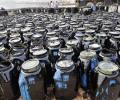
India's Iran imports rise to 276,800 bpd vs 195,600 bpd in 2013.

'If the temperature remains very high, which is likely to be the case because of El Nino, it may lead to a shortfall in wheat production.' 'If that happens, we will be in a very, very difficult situation as far as food security is concerned.'

The US House of Representatives has passed the Lindsey O Graham Sanctioning Russia and Iran Act of 2026, authorising President Trump to impose sanctions on Russia's energy sector and tariffs on countries like India and China that purchase Russian oil and gas. The legislation aims to curb Russia's ability to evade existing sanctions and reduce global dependence on its energy exports, despite some Democratic opposition to increased tariff authority for the President.

'If you listen to a rowdy in a class, he will keep on bullying you.' 'India can say do whatever you want. We will not compromise on anything.'

India's net oil import bill has jumped by 51 per cent to Rs 27,135 crore (Rs 271.35 billion) in the first quarter of current fiscal on the back of sharp spike in international oil prices.
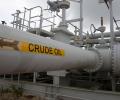
India will restrict crude oil purchases from Russia as part of an agreement reached with the US in exchange for lower trade tariffs, sources said, adding imports will continue for now by refiners such as Nayara Energy, which have no other alternative source. US President Donald Trump announced overnight that the United States will cut the reciprocal tariff on imports of Indian goods to 18 per cent from 25 per cent under a broader bilateral understanding.

Hardeep Singh Brar, President and CEO of BMW Group India, has urged state governments like Delhi to remove price caps on road tax benefits for electric vehicles (EVs), arguing that such limits deter luxury-car buyers and hinder the transition to cleaner mobility in pollution-affected regions.

Despite decades of efforts towards energy transition, oil will remain the critical energy source for all nations for some decades. We can hope for peace opening the Strait of Hormuz, but must prepare for war closing it, points out former foreign secretary Ranjan Mathai.

Navigating this geopolitical minefield requires a cold-blooded blend of immediate tactical pleading, structural domestic diversification, and aggressive collective resistance, suggests Ambassador Rajasekhar.

The US announced a 60-day pause on sanctions against Russia and tariffs on other countries, including India, to analyse the global economic impact. This decision, made via an executive order by Trump, has drawn significant criticism from both Republicans and Democrats, who had previously passed the Lindsey O. Graham Sanctioning Russia and Iran Act. US officials stated the waiver allows for assessment of global energy pressures and European allies' refusal to impose secondary sanctions on Russian oil buyers.

Reserve Bank of India Governor Sanjay Malhotra has stated that the rupee may be 'undervalued' by many estimates and assured that the RBI will work to ensure its stability and help it find its 'correct value' amidst recent depreciation.

India's crude oil import bill is set to exceed $100 billion in the current fiscal year ending March 31, almost double its spending last year, as international oil prices trade at seven-year highs. India spent $94.3 billion in the first 10 months (April-January) of the ongoing financial year that started April 1, 2021, according to data from the oil ministry's Petroleum Planning & Analysis Cell (PPAC). It spent $11.6 billion in January alone when oil prices had started to surge.

'We expect the Indian delegation to flag New Delhi's worries and elaborate on its standpoint on the Russia-linked tariff as well as the Section 301 investigation into overcapacity.'

India bought 1.87 million barrels of Russian oil per day in May so far, meeting approximately 40 per cent of its oil imports.

'It is a blunt and dangerous attempt to pressure India to sign BTA on one-sided terms.'

State-run Oil and Natural Gas Corporation (ONGC) has made a significant gas discovery in the deep waters of the Mahanadi Basin off the Odisha coast, recording encouraging flow and sustained reservoir pressure, a breakthrough for India's deepwater exploration programme.

The Kremlin has stated that India is free to purchase oil from any country, dismissing claims that India agreed to reduce Russian oil imports. Russia maintains that energy trade with India benefits both nations and contributes to international energy market stability.

The United States has announced it will not renew sanctions exemptions for the purchase of Russian and Iranian oil, ending a 30-day waiver that allowed some countries, including India, to continue importing Russian oil despite sanctions related to the Ukraine war.

The benchmark Sensex plummeted 813 points to a three-month low, with the Nifty settling below 23,450, as escalating tensions in West Asia drove crude oil prices above USD 100 per barrel, leading to widespread selling in IT, FMCG, financial services, and oil & gas shares.

Trump has enacted a new law imposing significant sanctions on Russia and Iran, which could lead to tariffs of up to 100% on major energy importers like India and China.

Asian Development Bank (ADB) on Friday warned that India's limited crude oil reserves of about 100 million barrels - sufficient for only 40-45 days of consumption - leave the country particularly vulnerable to supply disruptions through the Strait of Hormuz amid the ongoing war in West Asia.

Indian government bond yields have recorded their worst losing streak in three decades, rising for the tenth consecutive week, driven by elevated crude oil prices and increasing global yields. The rupee also weakened, and India's foreign exchange reserves saw a significant decline.
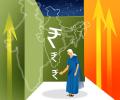
The International Monetary Fund (IMF) has increased India's growth forecast to 7 per cent for 2026-27, up from 6.4 per cent, attributing this robust outlook to resilient domestic demand and strong services activity, positioning India as one of the fastest-growing major economies.

India's crude oil imports from Russia fell for a second straight month in January to its lowest in 12 months but the nation's insatiable appetite for Russian crude remains for the long term, according to data from energy cargo tracker and industry officials. Russia supplied 1.2 million barrels per day of crude oil to India in January, down from 1.32 million barrels in December and 1.62 million barrels in November 2023, according to data from energy cargo tracker Vortexa. Russia however continues to remain India's top oil supplier, accounting for a little less than a quarter of 4.91 million barrels a day of oil that the world's third largest energy consumer imported in January.

Iranian Foreign Minister Seyed Abbas Araghchi on Saturday criticised the United States over its stance on Russian oil, claiming Washington was now "begging" countries across the globe, including India, to purchase Russian crude.

President Trump claims American tariffs imposed on India for purchasing Russian oil have negatively impacted Russia's economy, referring to India as Russia's major oil buyer. He also mentioned plans to meet with Putin and Zelenskyy, and claimed to have solved several wars, including the conflict between India and Pakistan.

India has strongly criticised the US decision to suspend the Permanent Labor Certification (PERM) program for eight major IT firms, including Indian giants like TCS and Wipro. New Delhi also condemned US Vice President JD Vance's description of foreign professionals as "indentured servants," calling it "unwarranted and deeply offensive." The move is expected to impact thousands of Indian tech professionals seeking permanent residency in the US and further strains bilateral ties.

Indian equity benchmark indices extended losses for a second consecutive session, with the Sensex dropping 143 points, driven by a sell-off in power, banking, and financial stocks, coupled with elevated crude oil prices and persistent FII selling.

India's merchandise exports increased by 19.63 per cent to USD 44.24 billion in July, primarily driven by petroleum products, while a significant rise in imports pushed the trade deficit to a six-month high of USD 31.98 billion.

Indian benchmark indices, Sensex and Nifty, saw declines in early trade, with the ongoing US-Iran standoff cited as a major factor impacting investor sentiment and raising concerns about inflationary pressures and currency volatility for oil-importing nations like India. Track Sensex, Nifty on August 14, 2026.

India is developing a 'Gross Domestic Knowledge Product' (GDKP) to identify and define its knowledge assets, a move aimed at safeguarding them amidst global efforts to monetise and 'weaponise' knowledge, according to NITI Aayog member R Balasubramaniam.

Analysts predict that the Indian stock market's sentiment this week will be primarily influenced by the domestic GDP data announcement, crude oil prices, and the crucial US non-farm payrolls report.

Replacing over a third of India's oil imports at competitive rates is going to be a challenge, said traders from State refiners, even though some progress was made in the last two months.
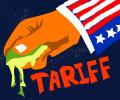
The bill, introduced on Thursday, was conceived by Democrat Senator Richard Blumenthal and late Republican Senator Lindsey Graham and has the support of over 60 lawmakers.

The Reserve Bank of India's recent measures, including a dedicated dollar window for state-run oil marketing companies and tightened foreign exchange derivative rules, are expected to provide near-term relief to the rupee's depreciation, but market participants believe global factors and balance of payment dynamics will continue to exert pressure in the medium term.

The US House of Representatives has advanced a bill that would empower President Donald Trump to impose 100 per cent tariffs on countries, including India, that purchase oil and gas from Russia, and also extend sanctions on Iran. The legislation, which previously passed the Senate, aims to curb Russia's energy revenue amidst the Ukraine conflict.
